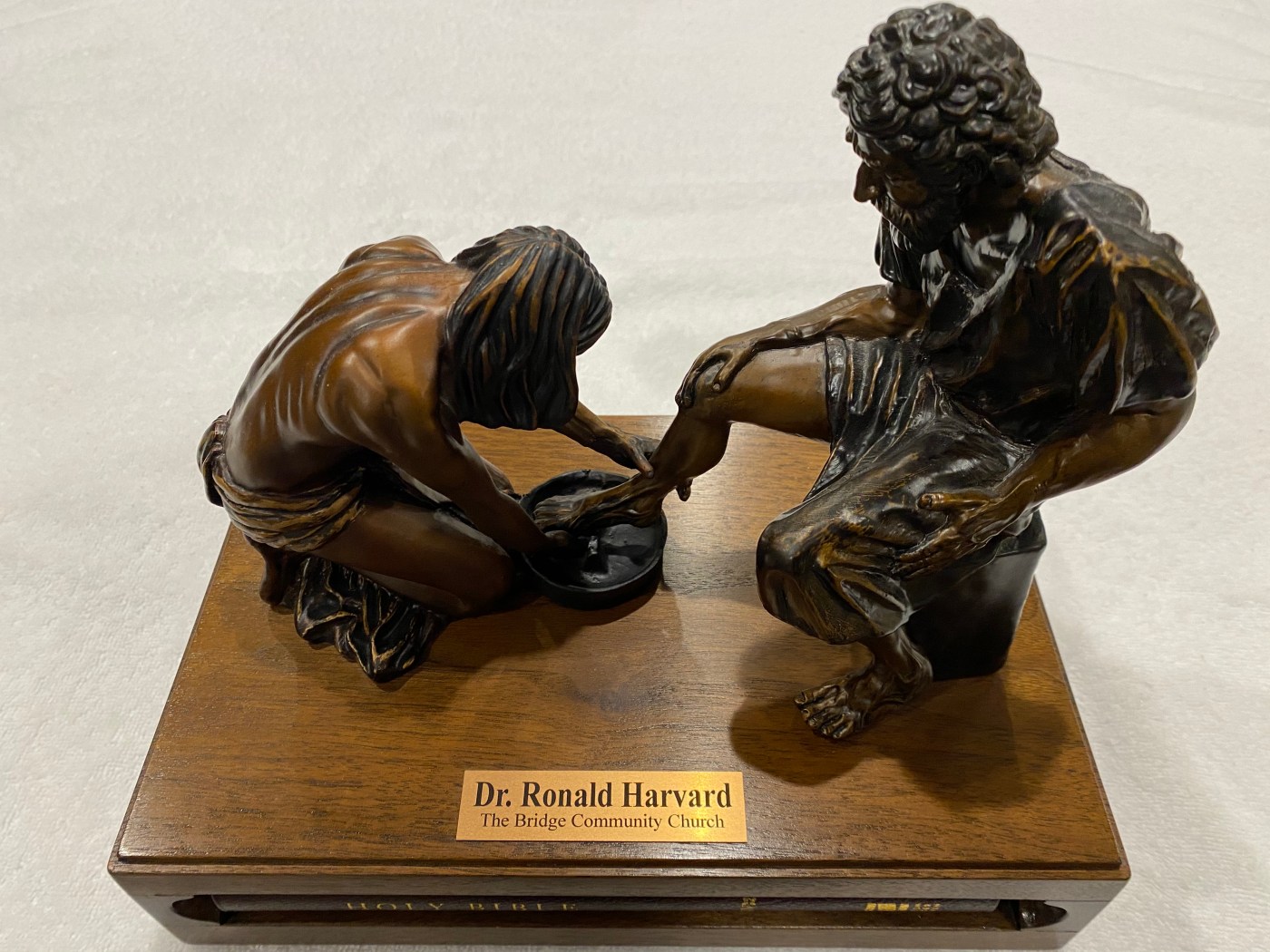
Jesus was the greatest teacher who ever lived. His capacity to share profound truth through parables never ceases to amaze me; however, even that is surpassed in his teaching by example. On the last night of his life on earth, we are invited to witness as he demonstrates his love for his disciples, and calls upon them to serve one another in humility:
An Unforgettable Pictorial
It was just before the Passover Festival. Jesus knew that the hour had come for him to leave this world and go to the Father. Having loved his own who were in the world, he loved them to the end. The evening meal was in progress, and the devil had already prompted Judas, the son of Simon Iscariot, to betray Jesus. Jesus knew that the Father had put all things under his power, and that he had come from God and was returning to God; so he got up from the meal, took off his outer clothing, and wrapped a towel around his waist. After that, he poured water into a basin and began to wash his disciples’ feet, drying them with the towel that was wrapped around him (John 13:1-5 NIV).
A Call to Action
…When he had finished washing their feet, he put on his clothes and returned to his place. “Do you understand what I have done for you?” he asked them. “You call me ‘Teacher’ and ‘Lord,’ and rightly so, for that is what I am. Now that I, your Lord and Teacher, have washed your feet, you also should wash one another’s feet. I have set you an example that you should do as I have done for you. Very truly I tell you, no servant is greater than his master, nor is a messenger greater than the one who sent him. Now that you know these things, you will be blessed if you do them (John 13:12-17 NIV).
Application of Truth
The picture accompanying this blog demonstrates God’s capacity to bring forth his purpose in unexpected ways. Prominently displayed in my office is a sculpture of Jesus washing the feet of his disciple, Peter. In 1986, Max Greiner, Jr., at a time in his life when God was teaching him about priorities and humility, was commissioned by God to create, “Divine Servant.” Upon my retirement from the pastorate on July15, 2012, a copy was given to me by The Elder Board of The Bridge Community Church. Little did I realize that in the coming years, God was going to refine my theological understanding of this great lesson, create within me a greater desire for service in his Kingdom, and launch my ministry in a new direction.
Each time I visit my wife, my heart is gladdened by the staff, nurses and caregivers who faithfully minister to those whom many in the world would like to forget. After all, they serve as an unwelcome reminder of the frailty and brevity of life. Last Friday, they were joined by the lady who has cleaned Linda’s teeth for years. Coming not in an officially paid capacity, rather as a part of the body of Christ desiring to fulfill the example of our Master; for nearly an hour, she served God by serving one of his suffering children.
The night before, Linda was very distracted; our Face Time visit lasted less than a minute. Upon arriving, when I saw her with closed eyes and trembling hands, my first inclination was to fearfully think, “This is not going to work.” Quickly reversing course, I silently prayed and busied myself as a helper. This involved taking her to the bathroom and cleaning her up afterward; inviting her to join me in singing You are My Sunshine when it seemed she may be signaling, “This is enough;” and the rest of the time holding her hand for assurance. Upon completion, when she looked in the mirror and saw her bright white teeth, she flashed that beautiful smile. For a fleeting moment, I almost forgot that things are not, and never will be again, as they once were.
Later, sitting in my car out front, I thanked God that even though we are living in a world that has seemingly gone mad, the Church, Christ’s body on earth, is still living out the biblical mandate for ministry:
The way God designed our bodies is a model for understanding our lives together as a church: every part dependent on every other part, the parts we mention and the parts we don’t, the parts we see and the parts we don’t. If one part hurts, every other part is involved in the hurt, and in the healing. If one part flourishes, every other part enters into the exuberance (1 Corinthians 12:25-26 MSG).
 Ron Harvard Ministries