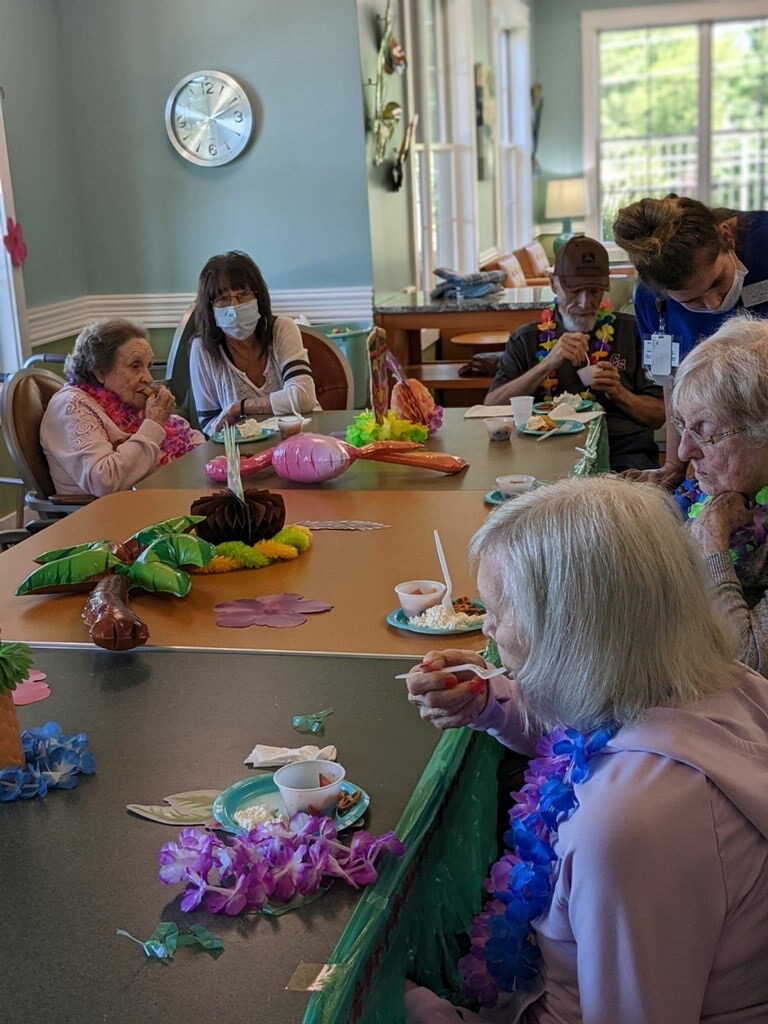
Before my wife, Linda, became a resident at Legacy Village, I, along with my family and paid caregivers, were able to meet all of her physical needs; however, the picture accompanying today’s blog, taken last week at a luau, vividly illustrates what I could not provide her – a social life with her peers, and the advantage of living in a community staffed with persons devoted to caring for individuals suffering from a wide range of disorders, which are commonly listed under the large umbrella of dementia.
In the past four years, I have spent hundreds of hours visiting with Linda. This has allowed me to build wonderful memories of our time together, which I will treasure after her homegoing. It has also afforded me an opportunity to observe residents, caregivers, and family members interacting. This unique vantage point has enabled me to formulate three guidelines for effective communication:
Accept Changing Limitations
From the beginning of our journey into the “Long Goodbye,” I searched for ways to keep the lines of communication open; however, I soon became aware of the painful reality that noble goals must give way to common sense. Things were never going to be the way they once were. The changes that she was facing were beyond her capacity to control. Therefore, I must find creative ways to deal with these daily, and sometimes moment by moment, changes. In many ways, this challenge was tantamount to hitting a continually moving target.
Expand the Range of Options
A commonly touted adage indicates that ninety percent of communication is nonverbal. Though imprecise, it highlights the reality that our words, actions, emotions, and facial expressions all come into play. In his excellent book, 5 Love Languages, Gary Chapman provides a framework for understanding this phenomenon. Here are a few examples of what I have observed:
- Words of Affirmation – A resident suffering uncontrollable changes in her behavior accused a caregiver of not caring for her and ended her verbal barrage by stating, “I hate you!” Taking it all in stride, the caregiver sweetly responded, “I love you!”
- Quality Time — Collectively, a young caregiver and a nurse singled out a resident for special attention. The caregiver’s heroic efforts to keep a resident seated in her wheelchair ended with the resident growing very frustrated and the caregiver displaying a sense of desperation on her face. A few minutes later, I saw the resident, utilizing her walker and, anchored to the experienced nurse by a gait belt, slowly walking down the hall. A willingness to go the second mile, for a few minutes, brought joy into the life of someone desperately needing a different mode of communication.
- Gifts – Leading the residents in a game, the Activities Director asked, “What special things did your kids enjoy while growing up?” Linda wanting to participate, but unable to understand the question, held up our clasped hands and said, “My husband.” If I were to list my favorite gift of all time, this expression of love would be near the top.
- Acts of Service – This expression of love is almost commonplace among caregivers; however, it would be a huge mistake to allow it to be thought of as such. Toileting, bathing, serving food, preparing for bed, and washing clothes are essential to the well-being of those who cannot care for themselves.
- Physical Touch – I never cease to be amazed at the effectiveness of this manner of communication. When all other options are gone, it is often utilized by residents as they silently convey, “I am here and I care.”
Redefine Success
Regardless of your best efforts, you are never going to always get it right. After leaving Linda, I often walk to my car wishing that I could have done a better job. Excerpts from recent notes in my journal illustrate this struggle:
- Near the end of our visit, I looked into her eyes and said, “I wish you could talk to me.” I then told her how much I loved her and that she was wonderful. She seemed confused and just looked at me with a faint smile. After sharing recent conversations that I had with her brother and our children, tears welled up in her eyes. My heart felt like it would burst!
- I fought back tears as I left the building and on the way to my car prayed in the Spirit. Once inside, I sat there for several minutes and tried to regain my composure. Had I tried to get my needs met at her expense? Were the tears involuntary, or had I touched an area of consciousness deeply imbedded in her being?
Celebrate if you hit the ball out of the park and downplay the times that you strike out. Under these circumstances, success is more about sincere effort than observable results.
 Ron Harvard Ministries